You can't prove someone cheats from their Steam profile alone. What you can see is whether the account looks like the ones that got banned later. We tested this on real data: 3,481 CS2 profiles captured before a VAC or game ban, compared with about 481,000 clean profiles.
What we found:
- HS% picks out a future-banned account only slightly better than a coin flip. K/D does no better than one.
- An empty friends list was 6x more common among future-banned accounts than among clean ones. Fewer than 50 matches played was 5.6x more common.
- High aim is suspicious only on a new account. A veteran with the same aim is below average risk.
- "Cheater" accusations on the comment wall showed up half as often on future-banned profiles.
- 45% of the bans landed on just five days and look like farm cleanups.
Where the data comes from
We run a free CS2 legit check. It estimates Trust Factor and cheating risk from a public Steam profile. It's our own estimate, since Valve doesn't show the real Trust Factor to anyone. We explain how the system works in what Trust Factor is in CS2.
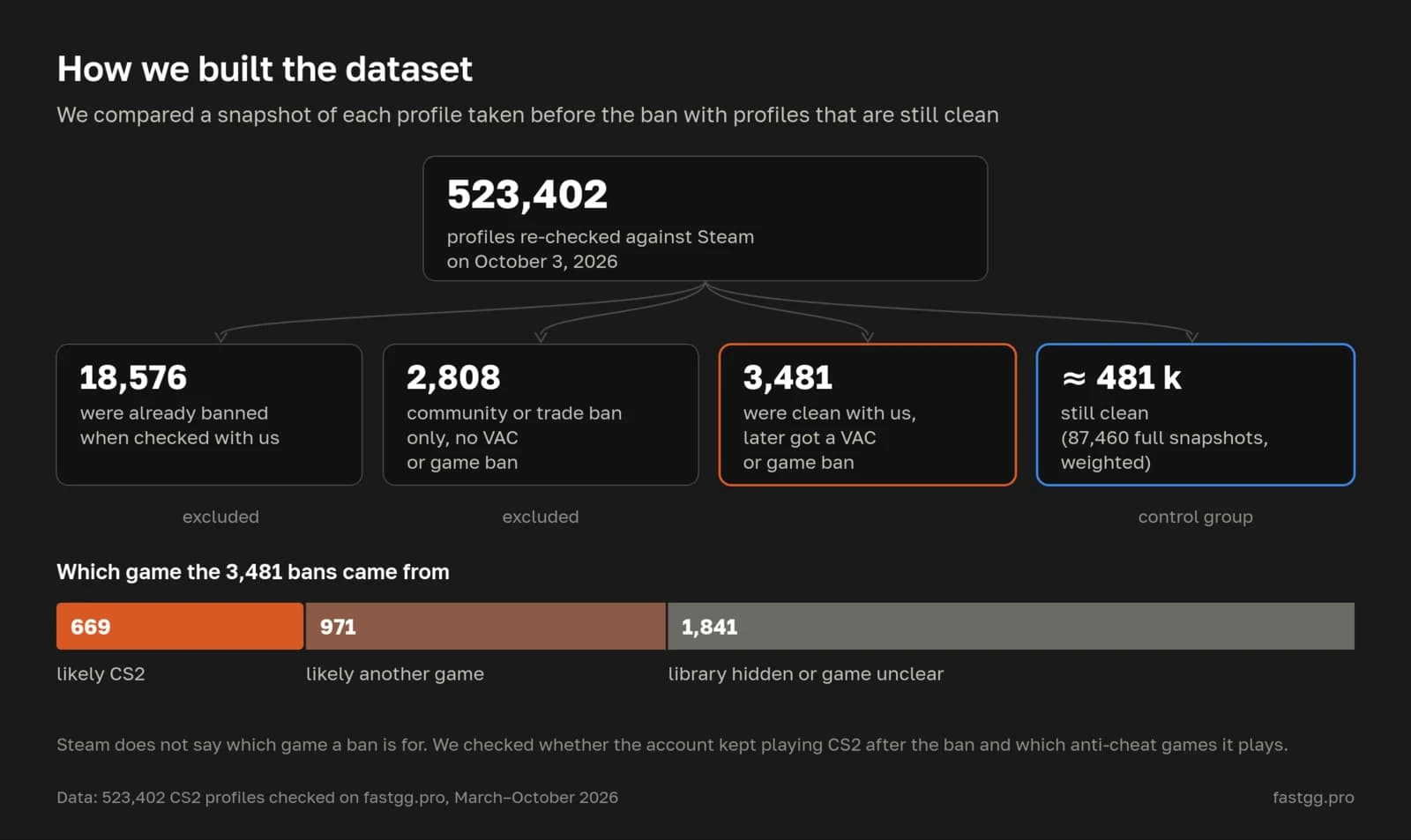
Between March 18 and October 3, 2026, people checked 523,402 profiles with us. On October 3 we asked Steam for the current ban status of every one of them. Then we dropped two groups:
- 18,576 profiles were already banned when they were checked. There's nothing to predict there.
- 2,808 profiles had only a community or trade ban, with no VAC or game ban.
That left 3,481 accounts. They were clean when checked and got a VAC or game ban later. For each one we have a snapshot of the profile taken before the ban. We compared those snapshots with about 481,000 clean profiles.
Of all the profiles we saw as clean, 0.72% got banned later. That's about 1 in 140. The data is anonymized: profiles are linked by hashes, and we only looked at group totals.
How we know the ban was for CS2
Steam doesn't say which game a ban is for. A VAC or game ban in CS2 closes matchmaking. So if someone keeps playing CS2 after the ban, it was probably for another game. We also looked at hours in games with their own anti-cheat, such as Rust, PUBG and DayZ.
That gave us 669 bans that are probably from CS2 and 971 from other games. About 1,800 we couldn't place because the library was hidden, empty or mixed.
Which profile traits show up before a ban
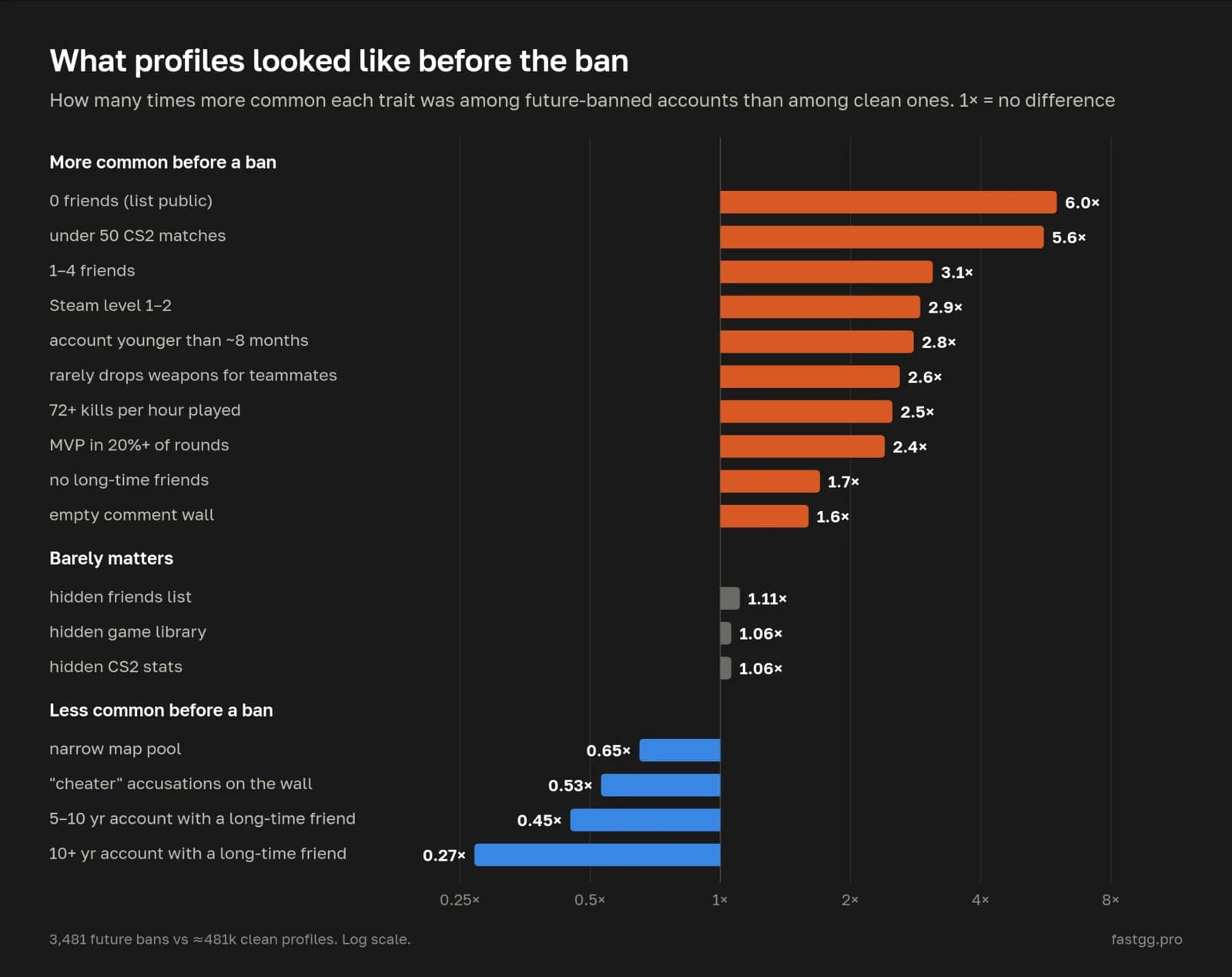
"6x more common" here means the trait appears 6 times as often among future-banned accounts as among clean ones. It doesn't mean 6 in 10 such players get banned. Bans are still rare.
These numbers cover all 3,481 bans, including the ones that are probably from other games. Where we have a separate number for CS2 bans, we give it.
The strongest signal was an empty friends list on an open profile. It showed up on 6.9% of future-banned accounts against 1.15% of clean ones. Fewer than 50 CS2 matches with public stats was 5.6x more common. Steam level 1 or 2 and an account younger than 8 months were each almost 3x more common.
Playstyle differed too. Rarely dropping weapons for teammates was 2.6x more common among future bans. 72 or more kills per hour played was 2.5x more common. Being MVP in at least one round out of five was 2.4x more common.
Old accounts get banned less. An account 5 to 10 years old with at least one long-time friend was half as common among future bans as among clean accounts. For accounts over 10 years old with a long-time friend, it was about a quarter as common. That isn't "never": 4.7% of future bans were accounts older than 10 years. A narrow map pool was also less common among future bans (0.65x). Players who stick to the same few maps get banned less.
The bad signs usually come together: a new account, no friends, almost no matches. You'll see these accounts again below, in the ban waves.
Do HS% and K/D give a cheater away?
Barely. Take a pair of profiles, one future-banned and one clean. In 55 pairs out of 100, the future-banned one has the higher HS%. If HS% meant nothing, it would be 50. Among bans that are probably from CS2, it's 51. Once you know account age and friends, HS% adds nothing.
The exception is very high HS%, 64% and up. That was 2.8x more common among future bans.
K/D comes out at exactly 50 pairs out of 100, a coin flip. High K/D on experienced players and low K/D on new ones were each 1.7x more common among future bans. Put together, K/D tells you nothing.
When is good aim suspicious?
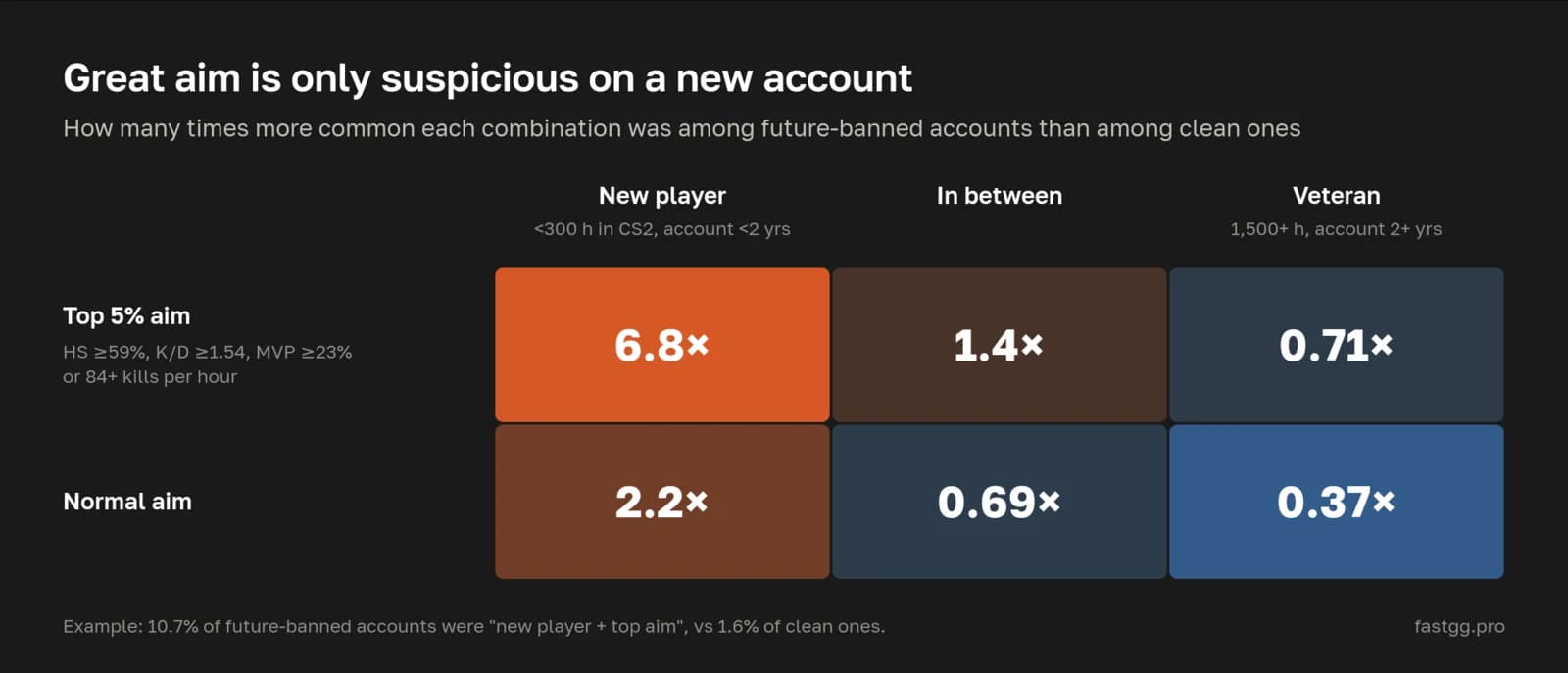
Only on a new account. We counted aim as top-tier if a player was in the top 5% on at least one stat. The cutoffs are HS% of 59 or more, K/D of 1.54 or more, MVP in 23% of rounds, or 84+ kills per hour. Then we split players by experience. A newcomer has under 300 hours in CS2 and an account younger than 2 years. A veteran has 1,500+ hours and an account older than 2 years.
A newcomer with top aim was 6.8x more common among future bans than among clean accounts: 10.7% against 1.6%. A veteran with the same aim was actually less common among future bans: 1.2% against 1.7%. The same aim is a red flag on a newcomer and means nothing on a veteran.
Are hidden friends, games or stats suspicious?
No. A hidden game library and hidden stats were each 1.06x as common among future bans as among clean accounts. A hidden friends list was 1.11x. That's noise. This is about hidden sections of an open profile. These numbers don't apply to a fully private profile.
What do "cheater" comments on the wall mean?
Comments like "-rep cheater", "wh" and "aim" were on 7% of future-banned profiles and 13% of clean ones. So they showed up half as often before a ban. Our explanation is a guess. People leave those comments on real, long-active accounts, and those get banned less. Hardly anyone writes on the wall of a throwaway account.
Readers of our Reddit post suggested another reason. A legit player doesn't delete accusations because there's nothing to hide, while a careful cheater wipes them. But plenty of legit players clean their walls too, and we didn't measure who deletes what. So this is a guess as well: the data shows a link, not a cause.
Ban waves: who gets banned in batches
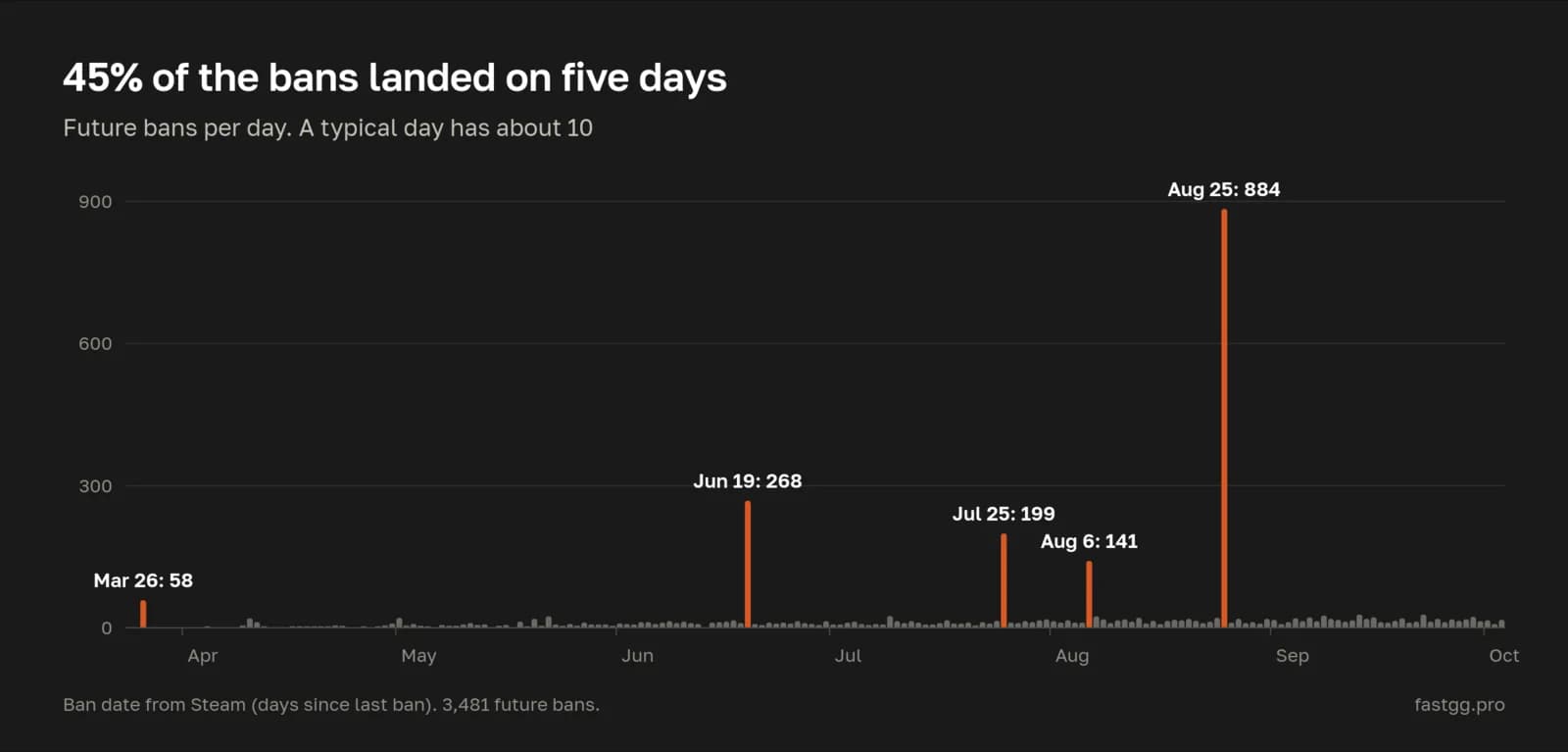
45% of future bans, 1,550 out of 3,481, landed on five days. On August 25 alone, 884 accounts from our sample were banned. June 19 had 268 and July 25 had 199. A normal day sees about 10.
Accounts from the waves look alike. The typical one is 9 months old, against 5.6 years for a clean account. Steam level 1 against 10, and 2 games in the library against 33. 15.8% of them have zero friends. 30% have comments on the wall against 70%.
Many wave accounts were created in batches. 54.6% of young wave accounts were registered on a day when at least three more like them were created. For random young clean accounts, that share is 30.5%.
Their aim is no better than clean accounts of the same age. They do get a lot of kills and die a lot. That's what deathmatch farming looks like, not an aimbot. Among wave accounts with an open library, only 2.9% played CS2 after the ban. That's why we think these bans were for CS2.
The waves look like farm cleanups. Steam doesn't give a reason for a ban, so this conclusion rests on indirect signs.
Single bans outside the waves look different. The typical account is 3.4 years old with Steam level 11, and its aim is better than on clean accounts.
Does the profile change before a ban?
Hardly. We checked some future-banned accounts twice before their ban. Their hours, friends, privacy and level changed the same way as on clean accounts.
One shift stood out. K/D went up for 32% of future-banned accounts against 15% of clean ones, counting players with 3 or more matches between checks. 87% of future bans don't have two checks before the ban, so this is based on a small part of the sample.
What does a high risk score mean?
High risk means the profile looks like the ones that got banned later. It isn't proof of cheating.
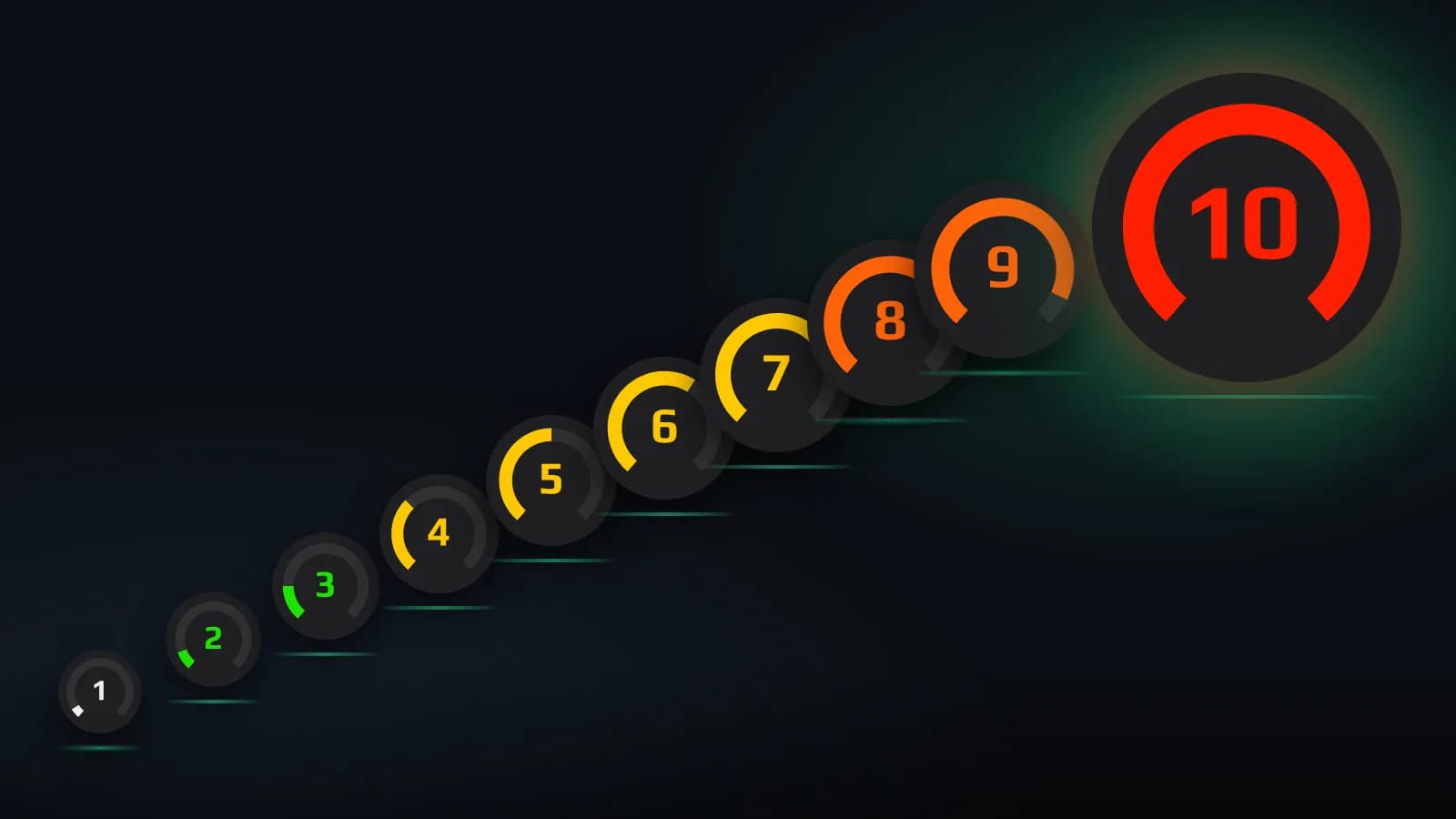
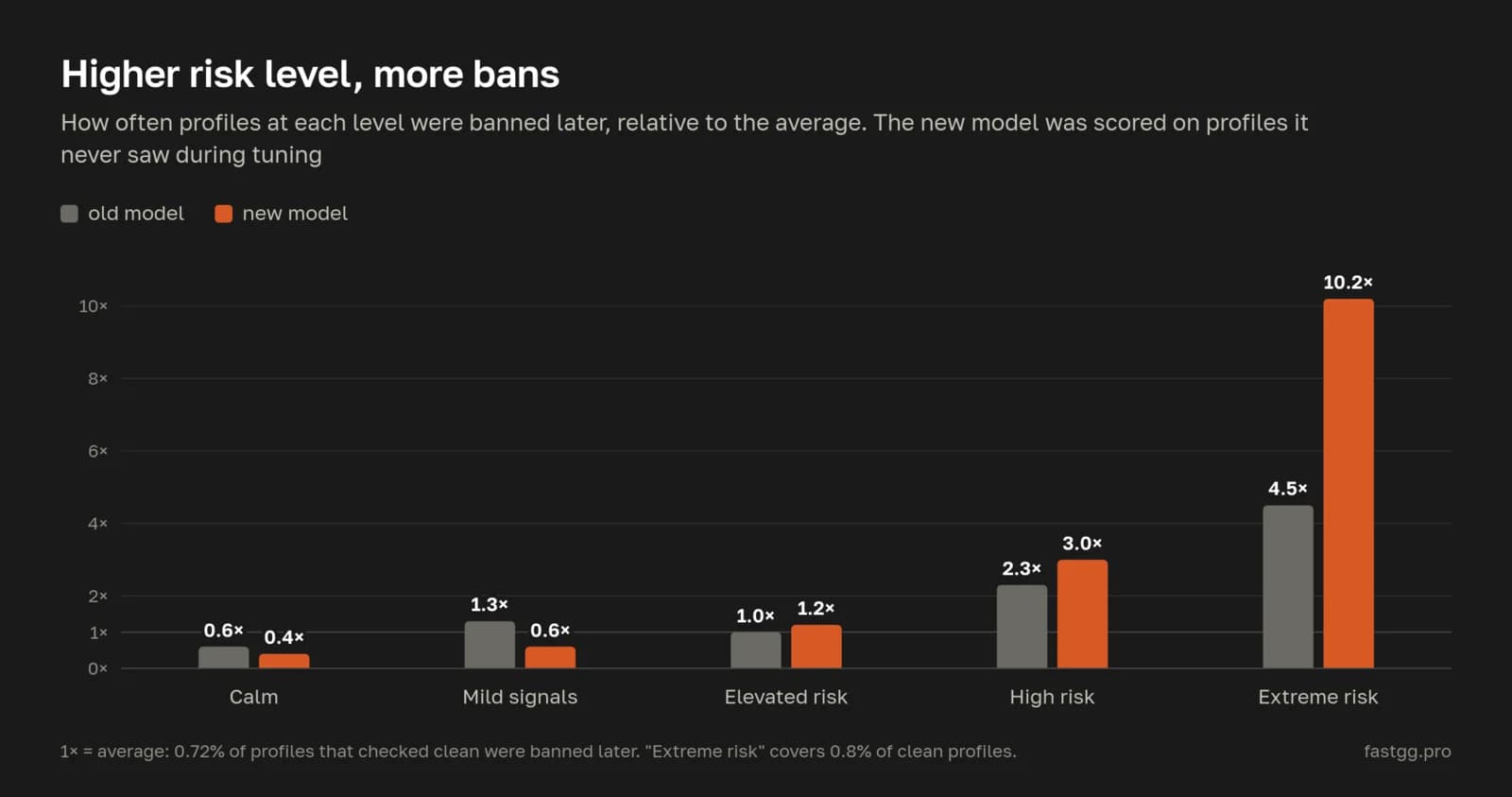
The check shows five levels: Calm, Mild signals, Elevated risk, High risk and Extreme risk. We tested the model on profiles it hadn't seen during tuning. Then we counted how often profiles at each level got banned later.
- Extreme risk covers 0.8% of clean profiles. 7.3% of profiles at this level were banned by October 3, 10x the average.
- High risk covers about 10% of clean profiles. 2.2% of them got banned, 3x the average. The other 97.8% were still clean on October 3.
- Calm covers 43% of clean profiles, and 0.26% of those got banned.
A new account, few friends and few matches raise the risk the most. That's why a legit newcomer can get High risk too. The longer the account history and the more long-time friends, the lower the risk.
We updated the model based on this data. A hidden library now barely raises the risk. Account age, long-time friends and match count carry more weight. Aim only counts once there are enough matches, and only together with experience.
We also compared the new model with the old one. Set the cutoff so that one in ten clean profiles gets high risk. At that cutoff the new model flags 39% of future bans, and the old one flagged 27%. Take a pair of one future-banned and one clean profile. The new model rates the future-banned one higher in 74 pairs out of 100, the old one in 63. For bans that are probably from CS2, it's 88 out of 100, against 79 for the old model.
You can see how the model rates your own profile with the free CS2 profile check. No Steam login needed.
What this data can't tell you
We see bans, not cheaters. Valve doesn't ban every cheater. So our data has profiles that look like cheaters by every sign but have no ban, and to us they count as clean. If the anti-cheat catches new accounts more often than careful cheaters on old ones, our data repeats that bias.
About 15% of future bans were mature accounts with ordinary-looking profiles. The model put them in the lowest risk tier. You can't tell them apart from a public profile.
Outside the waves, the model is noticeably weaker: 64 pairs out of 100, against 74 across all bans. It barely separates bans from other games like Rust. That's by design, since the model is built for CS2.
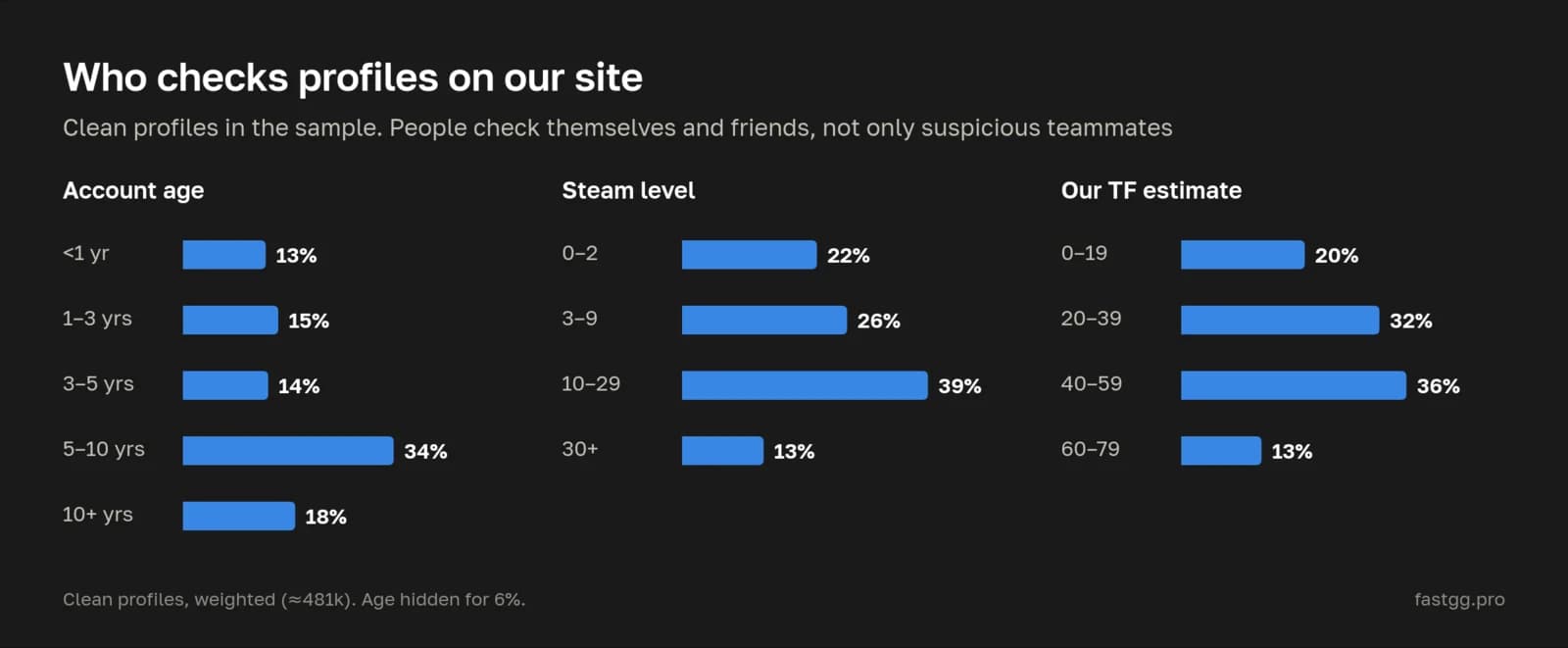
The sample is people who came to check a profile themselves. It isn't a random sample of CS2 players, but it isn't only suspicious accounts either. People check themselves and their friends. 34% of the clean profiles are 5 to 10 years old, and 39% have Steam level 10 to 29.
These traits describe what accounts looked like before a ban. They aren't the reason for it. Nobody gets banned for having zero friends.
Why this isn't a guide for cheaters
The signals that work can't be faked quickly. Account age, long-time friends and hundreds of matches take months and years to build. You can add 20 friends in an evening, but on the profile that looks like a lot of fresh friends. And Valve catches cheaters by their gameplay and the cheat itself, not by the profile.
Data as of October 3, 2026.