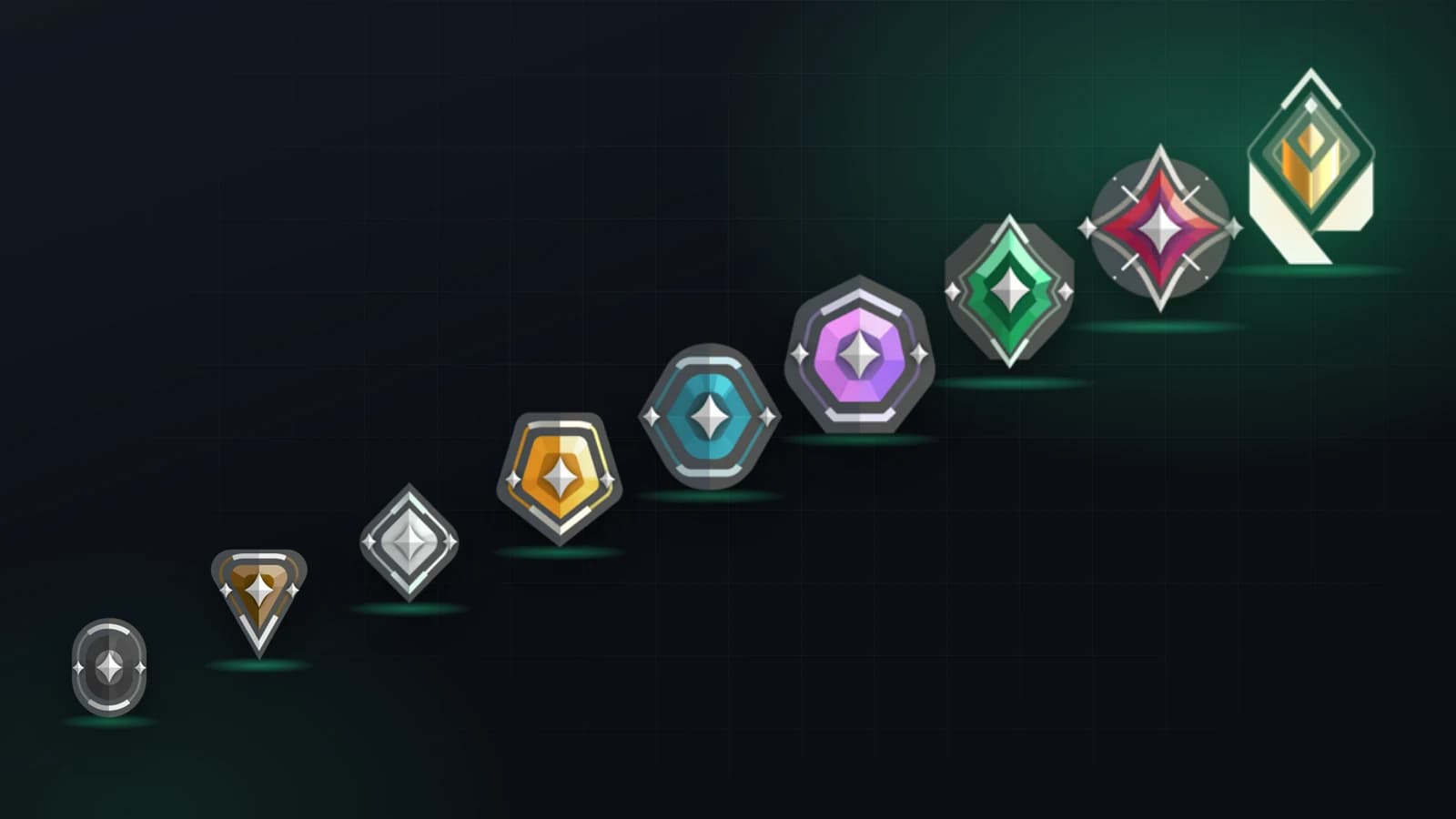
Valorant has 9 ranks and 25 tiers, from Iron 1 to Radiant. You move up a tier at 100 Rank Rating (RR), and the score plus your hidden MMR decide how much RR each win and loss is worth.
All Valorant ranks in order
Rank | Tiers | Share of players, Sept 2026 |
|---|---|---|
Iron | 1, 2, 3 | 4.7% |
Bronze | 1, 2, 3 | 15.7% |
Silver | 1, 2, 3 | 20.7% |
Gold | 1, 2, 3 | 22.1% |
Platinum | 1, 2, 3 | 17.6% |
Diamond | 1, 2, 3 | 11.6% |
Ascendant | 1, 2, 3 | 6.3% |
Immortal | 1, 2, 3 | 1.4% |
Radiant | No separate tiers | 0.05% |
Riot lists the ranks and their order in its Competitive Mode FAQ.
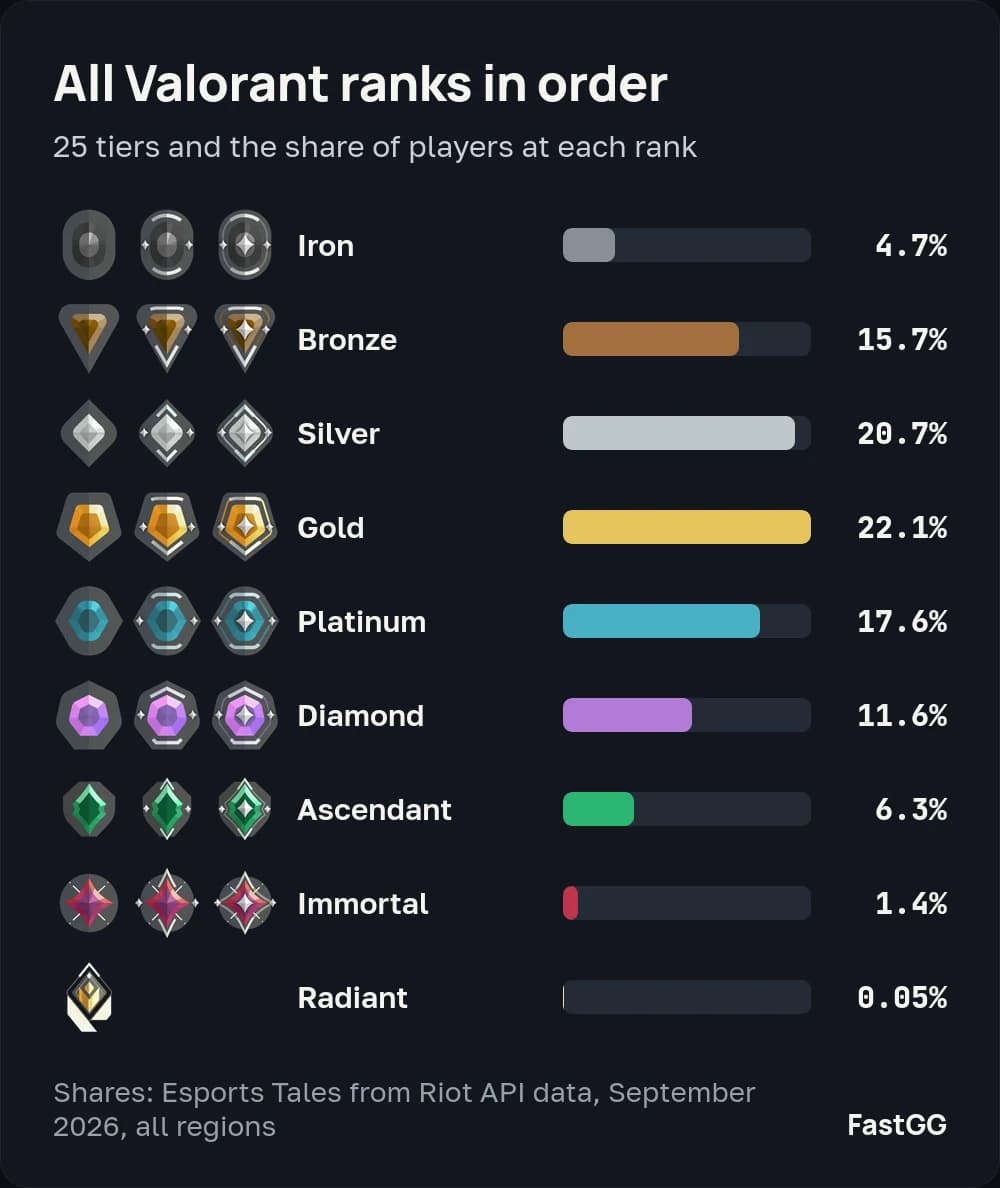
Gold and Silver are the most crowded ranks. Half of all players are Gold 2 or higher. Diamond 1 puts you in the top 19%, Ascendant 1 in the top 8%, and Immortal in the top 1.4%. The shares come from Esports Tales, based on Riot API data for September 2026, all regions combined.
How to unlock Competitive
Competitive unlocks at Account Level 20. You level up with Account Points (AP), which you get for every match in any mode. Longer matches and wins give more AP, and your first win of the day adds a bonus. Every 5,000 AP is a new level. AP only counts toward your Account Level, not your battle pass. Riot explains the system in its account leveling guide.
Account Level has nothing to do with your rank. If you played at least one ranked match before Episode 4 (January 2022), Competitive stays open below Level 20.
In Europe, Ascendant and higher players need multi-factor authentication through the Riot Mobile app to queue for Competitive. The rule came with patch 12.01 in January 2026.
How many Valorant placement matches do you need?
A Valorant Season lasts a year and has six Acts. At the start of Act 1 and Act 4, everyone plays 5 placement matches. In Acts 2, 3, 5 and 6, one match is enough if you already played those five. Matches count whether you win or lose.
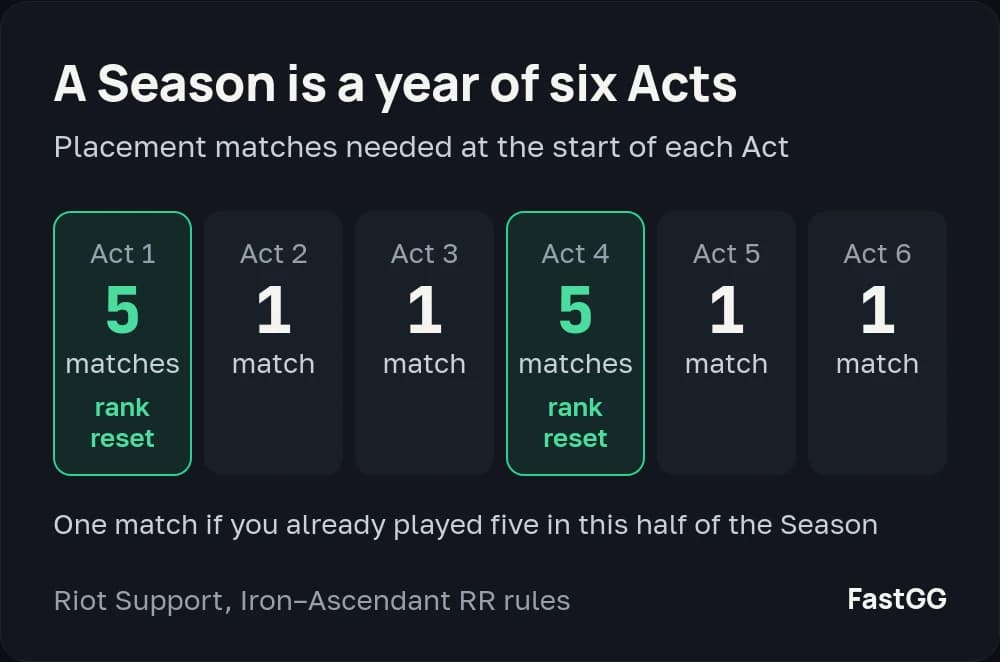
Placements will not put you higher than Ascendant. In the one-match Acts your rank does not drop by itself, but a bad placement match can lower it.
If you want someone to play these matches for you, see our Valorant placements service. You can order all five matches or only the ones you have left.
How promotion, RR and Rank Shields work
After placements you start your tier at 50 RR. At 100 RR you move up, and you get at least 10 RR in the new tier so one loss does not send you straight back. You drop a tier if you lose at 0 RR, and you land in the tier below with at least 70 RR.
If your MMR is far above your rank, the game can skip a tier on promotion, for example from Gold 1 straight to Gold 3.
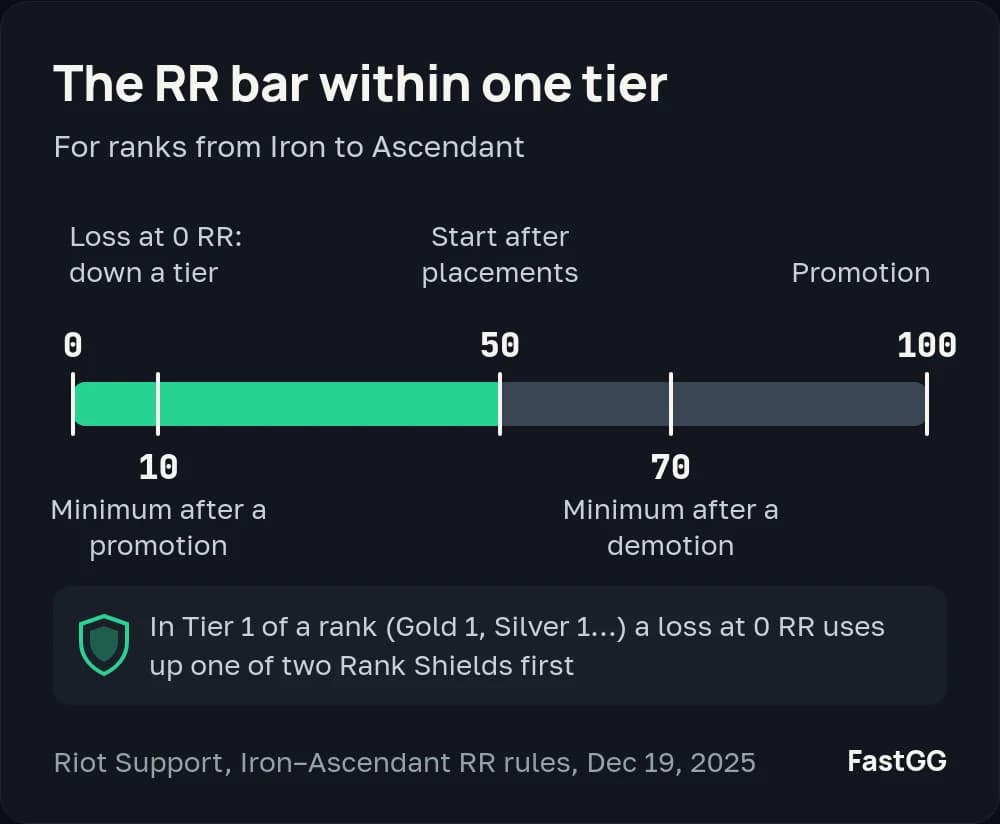
When you enter Tier 1 of a rank, such as Gold 1, you get two Rank Shields, whether you were promoted or demoted into it. A loss at 0 RR uses up a shield and keeps you in the rank. Shields do not cover drops between tiers of the same rank, such as Silver 2 to Silver 1. Dodging or a remade match does not use a shield, though frequent dodging costs RR. See Riot’s Iron–Ascendant RR guide for the full rules.
How to reach Immortal and Radiant
From Immortal 1, RR has no cap. You start at 10 RR, and the next tiers unlock at your region’s thresholds.
Region | Immortal 2 | Immortal 3 | Radiant |
|---|---|---|---|
EU | 100 RR | 200 RR | 500 RR |
NA | 90 RR | 200 RR | 450 RR |
APC | 80 RR | 200 RR | 400 RR |
BR | 100 RR | 230 RR | 340 RR |
LATAM, KR | 90 RR | 150 RR | 200 RR |
Radiant also requires a place in your region’s top 500. You drop out of Immortal 2 or 3 when you fall below that tier’s threshold. Radiant ends when you fall below its threshold or out of the top 500. The thresholds come from Riot’s Immortal and Radiant RR guide, updated March 30, 2026.
What is the difference between MMR and RR?
You can see RR in the game. MMR is hidden: it is your place on one ladder of all players. The game compares it with your rank to decide how much RR to give or take.
- MMR above your rank means wins give more RR than losses take.
- MMR level with your rank means gains and losses of about the same size.
- MMR below your rank means smaller gains and bigger losses.
The match result matters most, then the score. A 13-2 win gives more than a 13-9 win, and a 3-13 loss costs more than an 11-13 loss. Strong individual play, including damage and assists, can add a little to a win or soften a loss. At Immortal and Radiant it barely counts. A loss never gives RR, but it can still raise your MMR if you played very well. Riot’s RR calculation guide covers all of this.
Since June 2026, matchmaking tries to keep the two teams’ average ranks within one tier of each other. If your team averages Gold 2, the other team will usually average around Gold too (patch 13.00).
If you lose to a cheater, you get the RR back after they are banned. The refund arrives 24 to 48 hours after the ban, is applied after your next ranked match, and only works within the current Act. Refunds are capped, and they shrink if you have ranked up since that match.
Who can you queue with in Competitive?
Parties of two or three have rank limits.
Lowest rank in the party | Highest rank allowed |
|---|---|
Iron or Bronze | Silver |
Silver | Gold |
Gold | Platinum |
Platinum and above | One rank higher: Platinum 2 can queue with up to Diamond 2 |
Four-player parties are not allowed. From Immortal 1, you can only play solo, duo or as a five-stack. A five-stack can mix any ranks, but a wide rank spread or an Immortal or Radiant player in the group cuts the team’s RR by 25 to 90%. Five-stacks also wait longer, since they only play against other five-stacks. The same Competitive Mode FAQ has the details.
What is Act Rank?
Act Rank is the highest rank at which you won a match during the Act. It uses your rank after the match: if a win promotes you to Diamond 2, your Act Rank is Diamond 2. That is why it can be higher than your current rank. A Diamond badge from a past Act does not mean you are Diamond now.
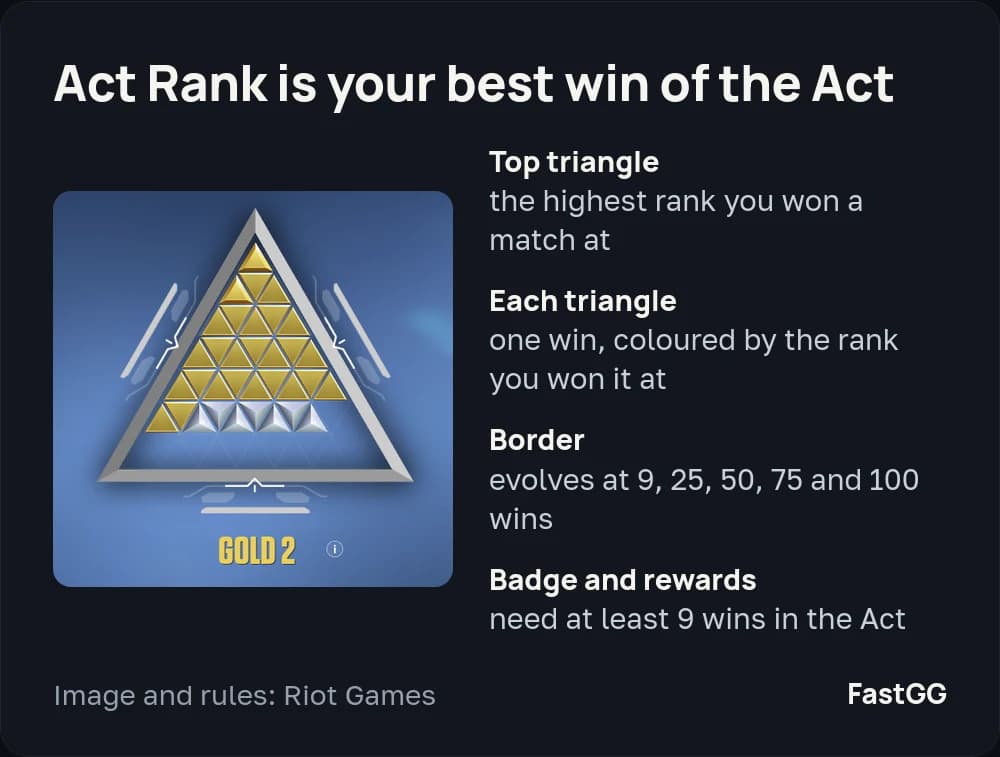
In the game, Act Rank is a pyramid. Each triangle is one win, coloured by the rank you won it at. The border around the pyramid evolves at 9, 25, 50, 75 and 100 wins. You only get the Act Rank badge and ranked rewards with at least 9 wins in the Act, and they arrive when the Act ends. Riot’s Act Ranks and Rewards article has more.
Since September 2026, Career also has Rank Legacy, which counts how many times you have reached each rank. A rank counts at most once per half-Season, and demoting into a rank does not count (patch 13.06).
When does Valorant reset ranks?
Ranks reset twice a year, at the start of the Season and at Mid-Season, before Act 1 and Act 4. After a reset, everyone plays five placement matches. There have been no Episodes since 2025: Riot replaced them with a year-long Season of six Acts in patch 10.00.
In 2026, ranks reset in January with patch 12.00 and in late June with patch 13.00. The next reset comes at the start of Season 2027.
A reset does not wipe your MMR. Riot only adjusts it slightly based on your placement results. If you place lower than your old rank, wins will give you more RR until your rank catches up with your MMR.
Does your rank decay if you stop playing?
No, a break does not lower your rank. At Immortal and Radiant, only your leaderboard position can change. To stay on the leaderboard, you need at least one Competitive match every seven days, a separate leaderboard rule.
Working toward your next rank
Compare how much RR you gain for a win with how much you lose for a defeat. If wins give clearly more, your MMR is above your rank and you will climb faster. If losses cost more, your rank is ahead of your MMR, and only steady wins will bring them back in line. You do not need a new account for this, since MMR changes after every match.
For economy, buying and movement, see our Valorant beginner’s guide. For shooting, see the Valorant aim tips.
If you want a booster to climb for you, see Valorant rank boosting. The price depends on the tiers between your current and target rank, and the booster plays on your region’s server. If you are only a few wins short of a promotion, you can order a Valorant win boost of 3 to 20 wins instead.